Our LEGEND…
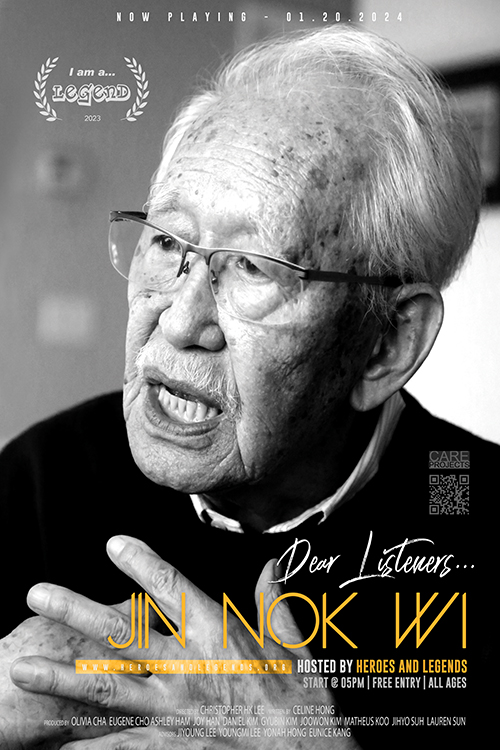
Jin Nok
Wi
By Celine Hong (16)
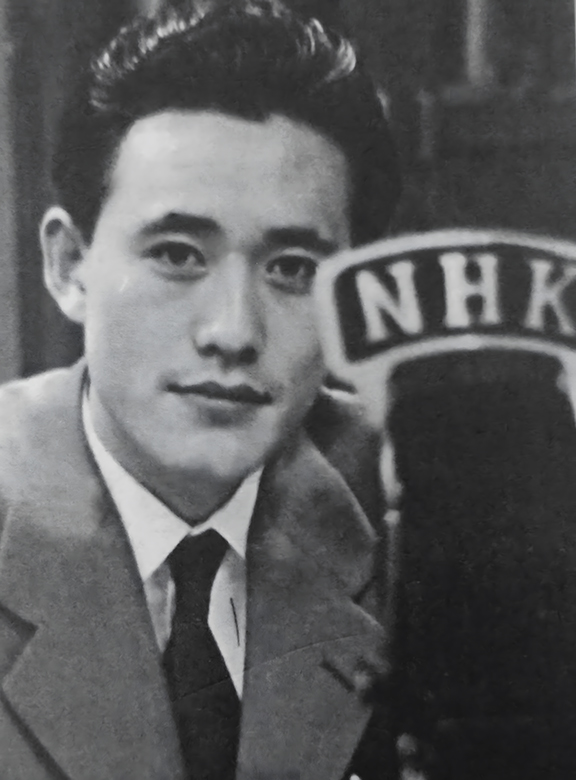
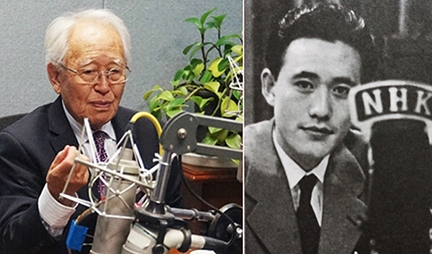
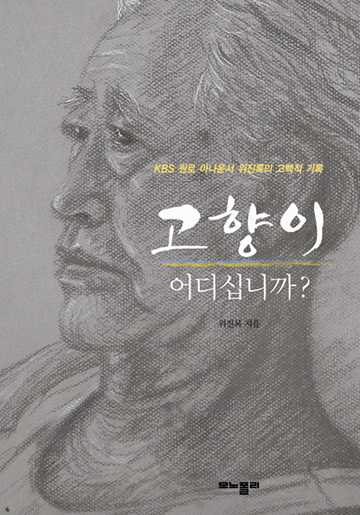
A former Korean announcer at Seoul Central Broadcasting Station (KBS), reported the first North Korea’s invasion of the South at 6:30 in the morning on June 25, 1950.
Anne Frank once said, “No one has ever become poor by giving”. What is important is not what you accomplish, but what you have selflessly given to others. Growing up, I struggled with finding something I could feel passionate about. Without any intense desire for anything, my actions were not at their best, lacking the meaningful purpose I wanted to fulfill in life. I grew up fully exposed to the Los Angeles community, being immersed with lots of wonderful people with many years in the workforce. My father, a lawyer, allowed me to gain a better understanding of our Korean American community. He introduced me to individuals who have advocated for our community and led meaningful lives, with their passion for others driving them.
The one person who had the most influential impact on my life is Mr. William Min. At the time, I had a lot of activities I was interested in. However, even when I enjoyed or excelled at them, there were none that had my extreme dedication and commitment. Although I was aware of Mr. Min’s accomplishments and acts of service to our Korean American community, I never realized how much of an impact he had until I grew older. I learned that the meaning of life is serving others. He has been involved in my life since the day I was born. Our families were always meeting, whether it was for celebrations or community events. It took me years to understand and take into full account the meaning of Mr. Min’s accomplishments. They had much more meaning than wanting fame or recognition.
As a child of immigrant parents, I am well aware of the difficult journey it takes to start a new chapter in a foreign land. Being thrown into the intricate processes of cultural adjustment and navigating through the nuances of language, social norms, and customs proves to be overwhelming for people who come from a seemingly different world. Language, in particular, becomes a major barrier that prevents one’s ability to communicate, greatly hindering their opportunities for employment and integration into a new society. Thus, their inability to communicate and their differences in culture are what prompt the prevalence of discrimination and stereotypes based on ethnicity, adding another layer of complexity and fostering a feeling of alienation. These challenges ultimately illuminate the multifaceted nature of the immigrant experience and underscore the resilience required to overcome these hurdles.
Recently, I encountered a remarkable individual who witnessed, experienced, and persevered even after going through the immigrant experience. Despite the difficulties, he valiantly accomplished a myriad of achievements and continued to document his memories and perspectives, generously sharing them with the world. His resilience and commitment serve as an inspiration not only to immigrant families but also to the younger generation, offering a valuable testament to a life richly lived and a legacy worth emulating.
Jin Nok Wi was the second son among a family of nine daughters and two sons. Born in 1928 in Jaeryeong, Hwanghae Province, during the Japanese colonial era, Wi underwent a Japanese education in his formative years until he entered elementary school. However, his already financially constrained family was struck with tragedy when his father passed away. This event led to Wi’s nomadic experience, with relocations to various places, including Kaesong and Seoncheon, North Pyongan Province.
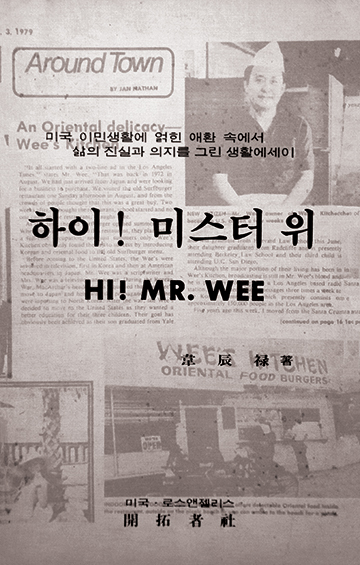
“Hi, Mr. Wee!” - A life essay depicting the truth and will of life amidst the sorrows and sorrows of immigrant life in the United States.
In 1940, he enrolled in Pyongyang Normal School, but his academic journey took an unexpected turn in his third year when he was expelled from underage smoking at the age of 15—a habit that would continue until his forties. This incident would prove to be an incredibly difficult time in his life, where he strived to educate himself to make a living. Enduring a life marked by poverty and grappling with sadness and loneliness from a young age, his lack of formal education led him to navigate existence as a lone wolf, placing unwavering faith in himself. The teachings of his role model, Jesus’ Sermon on the Mount (which he encountered at the age of 14 or 15), emerged as a steadfast pillar of support during the challenging chapters of his life.
His ambitions ventured him into the workforce, where he initially took on the role of a company handyman and later became a stationman at Seoul Station before the era of liberation. After the Korean War, he spent an extensive 22 years working at the ‘United Nations Command Broadcasting (VUNC)’ in Tokyo, Japan, immersed in Japanese culture for a span of 39 years.
Driven by his aspiration, Wi self-taught and mastered Hangul and successfully cleared the first round of recruitment for broadcast theater researchers at KBS in 1947. Making his mark in radio drama, he notably secured the role of voice-actoring an uncle in the children’s serial drama ‘Ddoltoli’s Adventure,’ contributing to the inception of a new chapter in Korean children’s dramas alongside ‘Ddoltoli (Gumin).’ This drama gained the highest listenership of its time, chronicling the adventures of an elementary school student and their companion, tackling challenges together through the power of love and friendship. But to do this, Wi recognized the unique demands placed on voice actors, who convey emotions solely through their voices, so he embarked on a journey to acquire a range of vocal techniques, including the breathing method of vocalization developed by Konstantin Stanislavski, a notable Russian stage director and theater theorist.
He also found himself taking on a significant role as the main character in Korea’s inaugural serial broadcast drama, <Cheongsilhongsil>, where he was entangled in a love triangle with Jang Min-ho, a legendary and famous Korean singer, model, dancer, and TV presenter. In essence, one could argue that he became Korea’s first broadcaster capable of seamlessly navigating both the roles of an announcer and a voice actor. At times, he reflects with a smile on his face, acknowledging the diverse paths he has shaped.
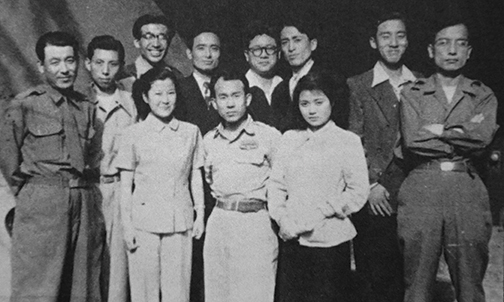

Notably, in September of the same year, he achieved a milestone by passing the KBS announcer recruitment, becoming a national broadcast announcer at the remarkable age of 19, and setting a world record for the youngest announcer to date. His memory remains vivid of the time when his senior announcer, Min Jae-ho, offered implicit encouragement to pursue the announcer test even though he lacked the academic qualifications. Despite fierce competition, with only 19 out of 120 applicants securing one of the three positions, he emerged victorious with the highest score. Reflecting on this achievement, he recognizes that the feat of becoming an announcer at a country’s central broadcasting station at the age of 19 was, and still remains, a record worthy of the Guinness Book of World Records, a testament to the challenges overcome seven decades ago.
In 1948, he claimed victory in the KBS 1st Broadcast Drama Competition. In 1950, he etched his name in history by broadcasting the onset of the Korean War and the subsequent restoration of Seoul on September 28. Authoring and delivering the initial, widely recognized broadcast on the June 25 onset of the Korean War, he had little foresight that it would evolve into a broadcast chronicling the profound tragedy of ethnic conflict. The experience was markedly different when he announced the restoration of Seoul on September 28. The memory remains indelible, broadcasting from a temporary studio at the Yeonhui Transmission Center with an impassioned plea to the citizens of Seoul as if crying out in the process.
In this same era, he dedicated himself to the broadcasting industry, presenting not only musical compositions like Tchaikovsky’s Symphony No. 6, Pathétique, with its poignant Andante that held a special place in his heart but also providing coverage for numerous pivotal historical events. His broadcasting journey extended to capturing significant moments in Korean history, including the solemn funeral proceedings of Mr. Kim Gu.
After these historical feats, he was initially dispatched to the United Nations Command Broadcasting (VUNC) in Tokyo for a month and ended up dedicating 22 years to working in Tokyo and Okinawa before making a life-altering move to the United States. This marked the official point where he quit smoking for good. Since that moment, he has pledged to never touch another cigarette again, rewarding him with good health and a long life.
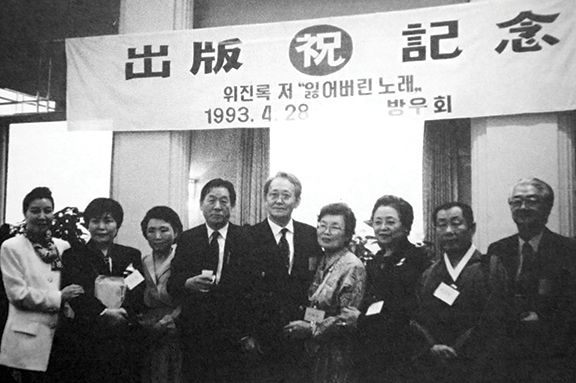
In 1972, Jin Nok Wi and his family arrived in the US, embarking on a journey that started with opening a hamburger store that lasted nearly a decade. During this time, Wi lived his daily life dealing with systemic racism, which was much more common at the time. In a society that was still new and unaccepting of foreigners, he recalled the young schoolboys that would pass by his store yelling, “Yellow! Yellow!” However, over time, as foreigners became more accepted and systemic racism was more emphasized, the calls that would address Wi would change as the voices of the once young children became deeper and more mature. Instead of calling him “Yellow,” the name “Mr. Wi” would stick instead. From then on, everyone would call out to him, saying “Hi, Mr. Wi!” which became the inspiration for the title of his best-seller book. In his book, Wi traced back on the lingering fear of death in a foreign land and the journey it took to become ‘Mr. Wi’. This book resonated with the hearts of many immigrants who related to his struggles and pain and also marked the start of his prolific writing career, which continued to share his stories and experiences.
Eventually, he ventured into the world of literature, establishing a bookstore and launching the local Korean newspaper, Korean News. Wi’s turning point came in 1979, when he published his inaugural book, “Hi! Mr. Wi!” marking the beginning of his prolific writing career. Later, he assumed the role of president of the Southern California Artists Association.
At the same time, Wi’s children were busy fulfilling their own accomplishments. His eldest son pursued a legal education at Yale University and Harvard Law School, eventually practicing law. Surprisingly, he transitioned to teaching at an elementary school, finding fulfillment in education for nearly three decades. Meanwhile, his daughter, a graduate of Harvard University and UC Berkeley Law School, initially excelled as a talented lawyer in New York. However, upon marriage, she chose to prioritize her children’s education, embracing the role of a dedicated housewife. The youngest son delved into public health, earning degrees from UC San Diego and graduate school. He dedicated his professional life to Kaiser Permanente, contributing significantly to the American medical organization over the years.
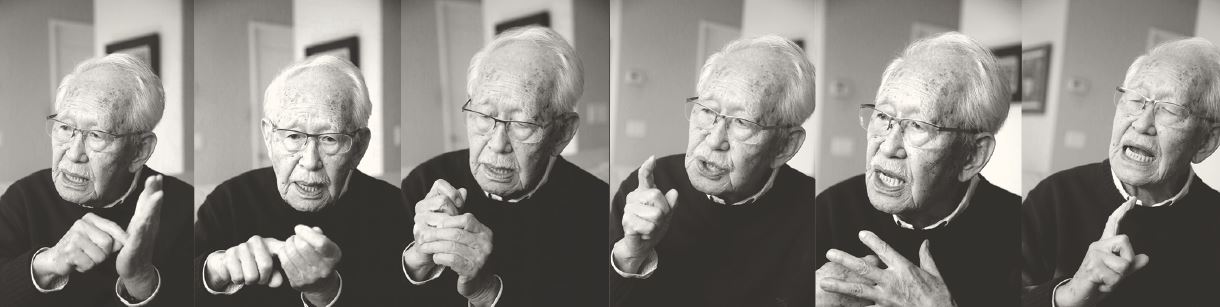
Currently residing in LA at the age of 95, those around him marvel at his surprisingly robust health and graceful aging. His daily routine involves walking approximately 5,000 steps every morning and evening, maintaining a steady pace for about 40 minutes. This habit has persisted for the past 50 years, undeterred by rain or wind.
Approximately two years ago, he relinquished his driver’s license, and the COVID-19 pandemic further curtailed his interactions with the outside world. His sole hobbies now include reading and indulging in classical music. Revisiting books on the Bible, world-renowned novels exploring human relationships, and works from his past, he finds renewed emotions and fulfillment in these intellectual pursuits.
In conclusion, the journey of this remarkable individual, from humble beginnings to becoming a pioneering announcer and voice actor, unfolds as a tapestry woven with resilience and determination. Navigating through the complexities of a changing world, he faced challenges head-on, leaving an indelible mark on the broadcasting industry and becoming a testament to the triumph of self-belief.
As an inspiration, his story resonates with the enduring power of perseverance and the ability to surmount obstacles. From the early struggles with poverty and limited education to the unexpected twists of a career spanning decades, his unwavering spirit serves as a beacon for those confronting adversity. The fusion of personal grit, a commitment to self-improvement, and finding solace in guiding principles illustrates that even in the face of uncertainties, one can carve a path of purpose and significance.
This narrative encourages us to embrace challenges, believe in our capabilities, and draw strength from our values. It reminds us that unexpected detours may lead to extraordinary destinations and that the journey itself holds valuable lessons. Ultimately, the story of this individual serves as a source of inspiration, urging us to forge ahead with resilience, conviction, and an unwavering belief in ourselves.